Project Management for Solo Developers: What Actually Works


The project management problem nobody talks about
There's a weird gap in the project management world. On one side, you have enterprise PM with Gantt charts, resource allocation, dependency mapping, and ten-person planning sessions. On the other side, you have "just use a todo list." Between these two extremes is where most solo developers live, and almost nobody is writing useful advice for that middle ground.
Every popular PM methodology — Agile, Scrum, Kanban, SAFe — was designed for teams. Multiple developers. Product managers. Stakeholders. Feedback loops that require other humans. Then someone decided to "adapt" these frameworks for solo developers by removing the team parts and keeping everything else.
That's like removing the engine from a car and calling it a bicycle. It doesn't work because the whole system was designed around a part you don't have.
According to the JetBrains Developer Ecosystem report, most solo developers who use team-oriented Kanban-style tools report that the tool itself doesn't improve their shipping rate. The PMI CHAOS report puts the overall project failure rate above 60% — and for solo builders without structured validation, it's almost certainly higher.
Solo developer project management is a fundamentally different discipline. And it needs a fundamentally different approach.
What project management looks like without a team
When you work on a team, project management happens naturally through social structures. Standups force you to articulate what you're working on. Sprint planning forces you to commit to scope. Code reviews force you to finish things to a shippable standard. Retrospectives force you to examine what went wrong.
Take away the team, and all of those forcing functions disappear.
Nobody asks you what you're working on today. Nobody questions whether that new feature belongs in this release. Nobody notices that you've been "almost done" with the same task for three weeks. Nobody points out that you've started four projects and finished none.
This is the fundamental challenge of solo developer project management. It's not that the work is harder. It's that the feedback loops that keep team projects on track don't exist. You have to build them yourself, and building them out of pure willpower doesn't work because willpower is unreliable.
You need systems that create those feedback loops automatically. Not by simulating a team — nobody wants to hold a standup with themselves — but by building constraints and visibility into your workflow.
What translates from team PM to solo work
Not everything about team project management is useless for solo developers. Some practices are genuinely helpful when adapted.
Scope definition
This is the most transferable practice, and arguably the most neglected. On teams, you write user stories or feature specs before building. This creates a shared understanding of what "done" looks like. Solo developers skip this because there's no one to share the understanding with. But the exercise of writing down exactly what you're building is just as valuable when you're the only reader.
Write down your features before you start coding. Be specific. Not "user authentication" but "email/password login, password reset via email, session persistence across browser restarts." When you know exactly what you're building, you know exactly when you're done. When you don't, you'll keep adding features because "done" is undefined.
Scope Locking formalizes this practice. You write your features, lock the list, and any modification requires an explicit unlock. The formality matters because it turns an informal intention ("I should stick to the plan") into a concrete constraint ("I literally cannot change the plan without recording why").
Milestone tracking
Breaking a project into milestones works the same whether you have one person or fifty. The difference is that solo milestones should be smaller and more frequent.
Team milestones might be "complete the payment integration" over two weeks. Solo milestones should be "payment form submits and charges a test card" by Thursday. Smaller milestones give you more frequent wins, and frequent wins are what keep solo projects alive.
Track your milestones with dates. Not "to do, doing, done" columns on a Kanban board. Actual dates when you planned to finish and actual dates when you did. The gap between planned and actual is the most useful metric in solo PM.
Retrospection
Looking back at what went well and what didn't is useful for anyone. For solo developers, a lightweight weekly review works better than a formal retrospective. Spend 10 minutes every week answering three questions: What did I ship? What did I plan to ship but didn't? Why?
The "why" is the important part. The reasons you didn't ship reveal the actual problems in your process. "I got distracted by a new project idea" is a scope problem. "The task was bigger than I thought" is an estimation problem. "I didn't feel like working on it" is a motivation or burnout problem. Each requires a different solution.
For more on tracking your progress, this guide on progress tracking goes deeper.
What doesn't translate (and should be thrown out)
Story points and velocity
Story points are a communication tool. They help a team develop shared language about effort. When you're the only person on the team, you don't need shared language. You know how hard something feels.
Velocity tracking (how many story points you complete per sprint) is similarly useless solo. It's designed to help teams predict capacity. Your capacity doesn't need predicting. You know how much time you have this week.
Sprint ceremonies
Daily standups, sprint planning, sprint review, sprint retrospective. These ceremonies exist because teams need synchronization points. You don't have a synchronization problem. You have an accountability problem and a scope problem. Simulating ceremonies won't solve either.
For a detailed breakdown of why sprint planning fails specifically, read why sprint planning is wrong for one person.
Backlog grooming
Maintaining a prioritized backlog of hundreds of items sounds organized. In practice, for solo developers, it becomes a procrastination tool. You spend time organizing and re-prioritizing instead of building. A short list of committed features and a separate "someday" list is all you need.
If prioritization is something you struggle with, this guide on prioritizing features offers a practical approach.
Burndown charts
Burndown charts visualize team progress against a sprint goal. For one person working on one project, you don't need a chart to tell you whether you're on track. You know. You either shipped things this week or you didn't. A chart won't change that reality.
The solo developer PM framework
Here's the solo developer project management system that replaces team-based methodologies.
Phase 1: Validate (Don't Build Yet)
The most important phase. And the one every solo developer skips.
Why it gets skipped: Building is fun. Validation feels like homework. And with no PM or stakeholder requiring a business case, there's nothing stopping you from jumping straight to code.
Why it matters: Most failed solo projects weren't killed by bad code. They were killed by bad ideas that never got challenged.
FoundStep's 7-step validation forces you through problem definition, severity assessment, existing alternatives, build feasibility, and personal motivation before you touch code. Takes 15 minutes. Saves months.
Phase 2: Scope and Lock (Define Then Constrain)
After validation, define exactly what you're building. Not roughly. Exactly.
- Five to seven features for your MVP
- Specific todos under each feature
- Effort estimates: small, medium, or large
Then lock it. Scope Locking prevents you from adding features without a written justification that lives in your Shame History permanently. This is the PM pushback you don't have. Except instead of a person saying "do we need this?" it's a system saying "explain why you need this, permanently."
Cutting scope is always free. Removing a feature requires no justification. This asymmetry — easy to cut, hard to add — is how solo developer project management should work.
Phase 3: Build (One Thing at a Time)
With scope locked, building becomes focused.
No backlog grooming. No sprint planning. No priority matrix. Just a locked list of features and todos, and AI Next Action telling you the single highest-impact thing to do right now.
Decision paralysis is a hidden tax on solo developer project management. Eliminate it by reducing decisions to zero: your system tells you what to do next.
Phase 4: Ship or Kill (No In-Between)
This is the phase team-based PM systems don't have because teams don't silently abandon projects. They have retrospectives. They have post-mortems. They have managers asking "what happened to Project X?"
Solo developers silently abandon projects all the time. The project sits in "in progress" for months, then years, collecting dust. Nobody asks. Nobody notices.
Your system needs to force the decision: ship it or kill it. There is no "pause." There is no "I'll get back to it." Ship the project live or kill it intentionally and move on.
Lightweight processes that actually help
If you're starting from zero, here's a sequence that works.
The one-page project plan. Before you write any code, write a one-page plan containing: project name and one-sentence description, 5 to 8 features, a ship date (a real date on the calendar), and a definition of done. This document is your entire project management system.
Weekly scope check. Every week, look at your feature list and ask: "Am I still building this, and only this?" If you've been adding features without noticing, you have scope creep. This weekly check takes two minutes.
Ship-or-kill deadline. Set a date by which the project either ships or gets killed. Not postponed. Not "revisited later." Shipped or killed. This deadline creates urgency that prevents the slow death most solo projects experience.
The accountability gap (and how to close it)
The biggest difference between team PM and solo developer project management is accountability.
On a team, accountability is built in. Your teammates see your commits. Your PM tracks your progress. Sprint reviews expose stagnation.
Solo developers have none of that. Nobody sees your commits. Nobody tracks your progress. Nobody asks why your project is stalled.
Closing this gap requires externalizing accountability:
- Shame History records every scope expansion with a written justification. You can't hide your decisions.
- Ship Cards display your unlock count publicly. Your scope discipline — or lack of it — is visible.
- Your Harbor shows only shipped projects. No "in progress" clutter. Your best workflow for solo developers becomes your resume.
You don't need a team for accountability. You need a system that makes your decisions visible and permanent.
What good solo PM actually looks like day-to-day
Here's what a daily session looks like when your system is working:
- Open your workspace. See your current phase, locked scope, and the single highest-priority next action.
- Do that one thing. No scanning a backlog. No re-prioritizing. One task.
- Complete it and move on. Tick the todo. Progress shows immediately.
- Ship when todos are done. Manual confirmation is your final step.
That's it. No daily journaling. No weekly reviews. No elaborate ceremony.
Compare that to the typical solo developer PM experience: open Notion, spend 20 minutes reorganizing your database, add three new ideas to the backlog, realize you don't know what to work on, close the laptop.
The difference is constraints. Constraints remove choices. Fewer choices means faster action. Faster action means shipped projects.
Common solo developer PM mistakes
Mistake 1: Skipping validation because you've "already started." Having code in a repo is not the same as validating an idea. Validate before building, even if you've already been building. Better to kill a 2-week project than a 6-month one.
Mistake 2: Defining scope as a vague list. "User accounts, dashboard, analytics" is not a scope. A locked scope has specific features with specific todos. Vague scope expands invisibly.
Mistake 3: Using a solo PM system as a team would. Running daily standups with yourself. Writing sprint retrospectives. Doing formal reviews. This is performance, not process. Solo developer project management should be invisible — it runs in the background while you build.
Mistake 4: Treating "almost done" as the same as "shipped." A project in your Harbor is shipped. A project you're "almost done" with is not. The distinction matters because "almost done" is where projects go to die. Nothing counts as shipped unless it's live, in front of users, and linkable. That standard keeps your definitions honest.
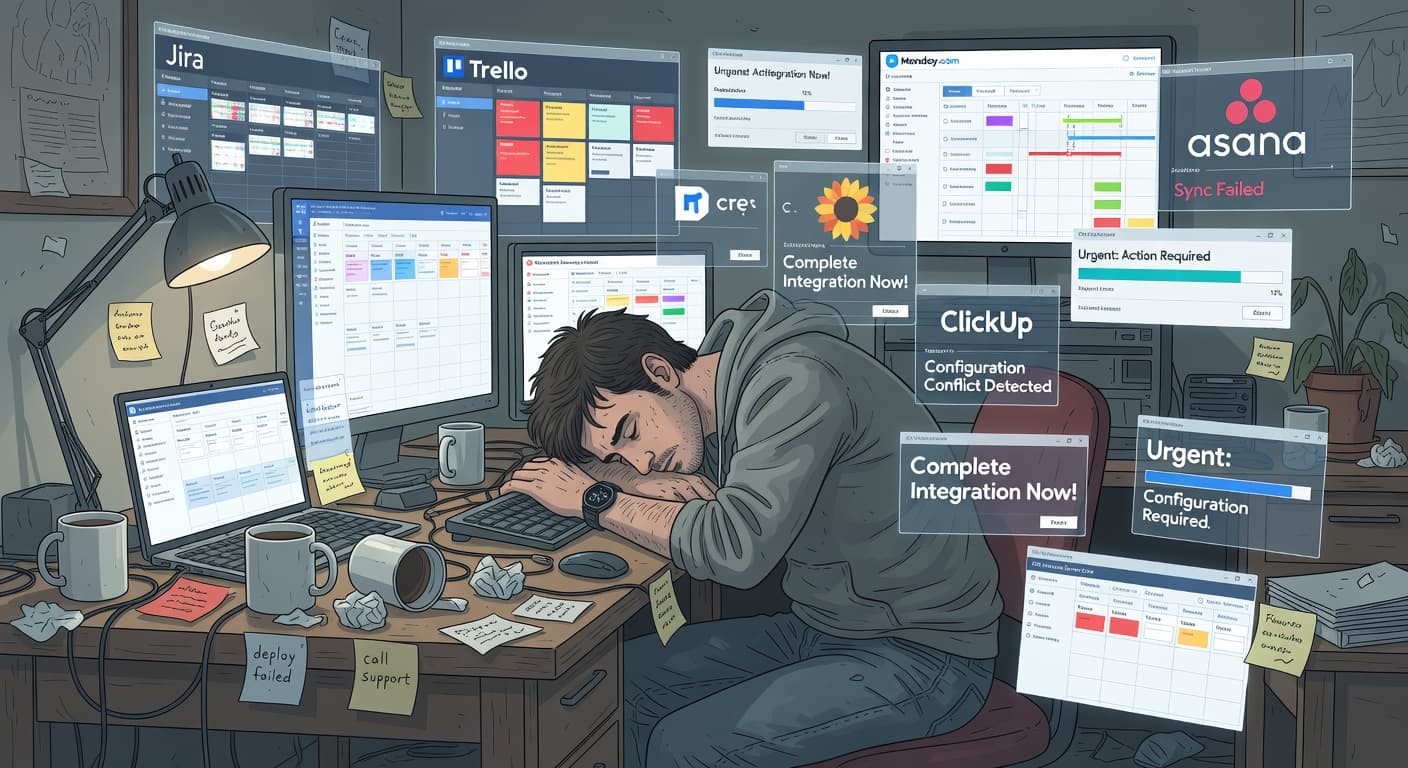
Mistake 5: Changing tools instead of changing habits. If Notion isn't working, switching to Linear won't fix the problem. The absence of validation, scope discipline, and lifecycle enforcement causes the failure. Those are habits, not features.
For a full breakdown of the best options available, check the best project management tools for solo developers comparison.
Start shipping with FoundStep — the project management system designed for solo developers who are done with team tools that don't fit. Validate, scope, lock, ship.

Ready to ship your side project?
FoundStep helps indie developers validate ideas, lock scope, and actually finish what they start. Stop starting. Start finishing.
Get Started Free