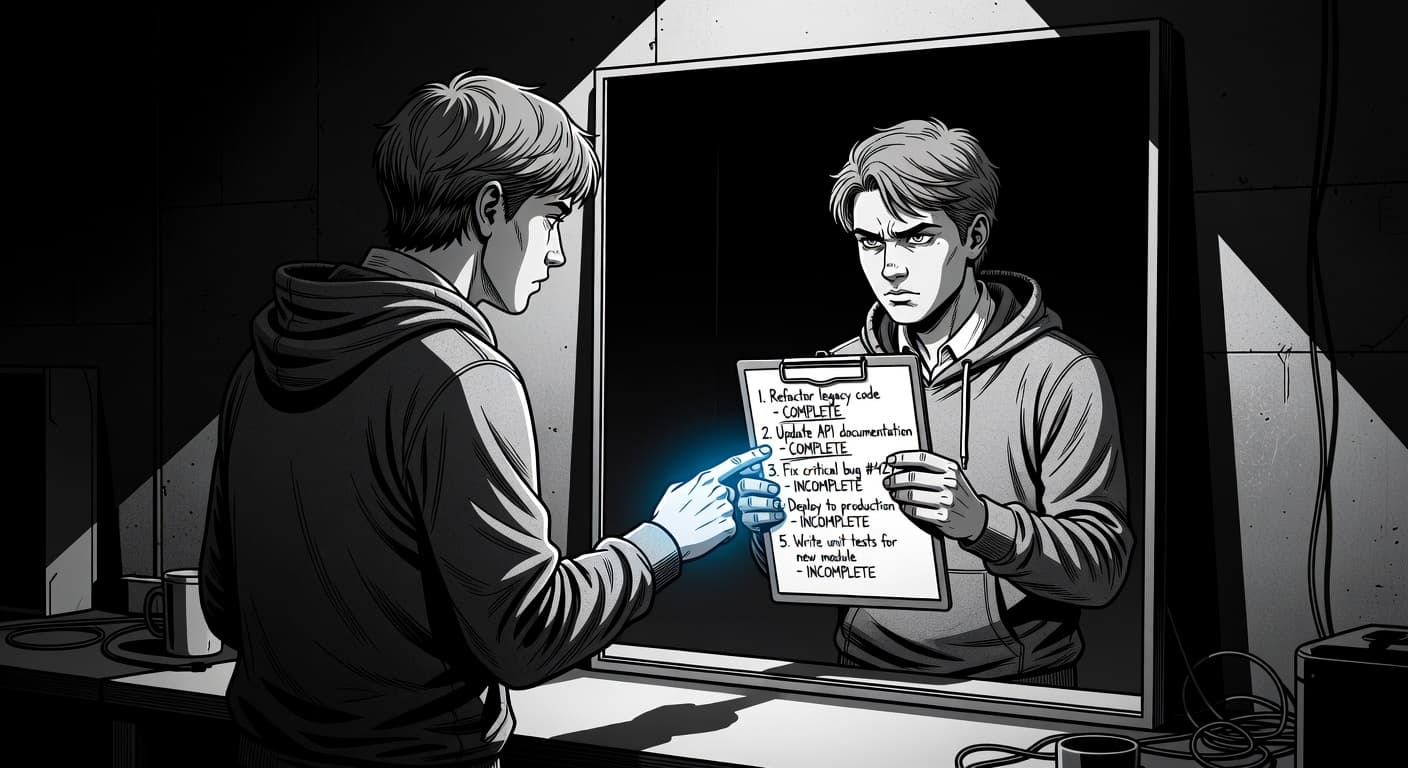
Side Project Motivation: Why It Fails and What Works Instead


Motivation Is Not Your Problem
Every few months, someone posts in a developer forum asking how to stay motivated on side projects. The responses are always the same: find your why, visualize success, set goals, remember your passion.
That advice is not wrong, exactly. It is just useless. Because motivation is not the problem. Relying on motivation is the problem.
Motivation is an emotion. It comes and goes like any other emotion. You would not build your work schedule around "I'll code when I feel happy." So why would you build your side project schedule around "I'll code when I feel motivated"?
Research on motivation and goal proximity supports this directly. Studies dating back to Lewin's field theory show that motivation increases as you get closer to a goal. The closer the finish line, the harder you push. The further the finish line, the more likely you are to quit. This has a direct implication: if you want to stay motivated, keep the finish line close. And the only way to keep the finish line close is to keep your scope small.
Community data from Indie Hackers consistently shows that solo builders who focus on one project at a time ship at dramatically higher rates than those juggling multiple active projects.
The developers who consistently ship side projects are not more motivated than you. They have just stopped depending on motivation as their primary fuel. They have replaced it with something more reliable: systems, habits, and structures that produce output regardless of how they feel on any given Tuesday night.
Why Motivation Always Fades
To understand why motivation fails, you need to understand what it actually is. Motivation is your brain's response to novelty and potential reward. A new project has both: new technology to learn, a new idea to explore, and the imagined future where your product is successful and people love it.
That neurological response has a half-life of about 2-3 weeks. After that, the project is no longer novel. The technology is no longer exciting. The imagined future is still there, but it is competing with the very real present, where you need to write database migrations and handle error states.
This is not unique to coding. It happens with exercise programs, musical instruments, language learning, and every other pursuit that requires sustained effort. The initial excitement carries you for a few weeks, and then you need something else to keep going.
The something else is not more motivation. It is structure.
The Five Structural Fixes That Make Motivation Automatic
1. Shrink Your Scope Until Shipping Feels Close
A 2-week project is motivating. A 6-month project is demoralizing.
Cut features until you could ship in 2 to 3 weeks. This is not about building something small forever. It is about shipping a small version, getting the dopamine hit of completion, and iterating from a position of success instead of a position of "still not done."
Ask: "What's the smallest version of this project that would be useful to someone?" Build that version. Only that version.
2. Lock Your Scope So It Can't Grow
Defining scope is step one. Keeping it locked is the hard part.
Your brain will try to re-expand scope constantly. "I should add dark mode." "Analytics would be nice." "What about a mobile version?" Each addition pushes the finish line further away and drains a little more motivation.
Scope Locking makes expansion require a written justification recorded permanently in your Shame History. That friction is enough to stop most "just one more feature" impulses before they kill your momentum.
Think of Scope Locking as a motivation preservation tool. Every feature you don't add is a feature you don't have to build, test, debug, and polish before shipping. The less scope you have, the more motivated you stay — because the finish line stays visible.
3. Make Progress Visible
Invisible progress is the motivation killer nobody talks about.
You've been working for two weeks. But when someone asks "what did you build?" you struggle to articulate it because nothing is "done." You've touched 15 files, fixed 20 bugs, and refactored 3 components. But you can't point to a shipped feature.
Your Harbor solves this at the project level. Ship a project and it appears in your personal gallery permanently. Ship Cards give you a shareable, visual proof of completion.
For daily tracking: keep a ship log. At the end of each work session, write one sentence about what you completed — not what you worked on, but what you finished. "Implemented user settings page." When motivation dips, read back through the log. You'll be surprised how much you've accomplished.
4. Work on One Project at a Time
Motivation for any single project is inversely proportional to the number of active projects competing for your attention.
Three active projects don't get 33% of your motivation each. They get 10% each because the remaining 70% is consumed by context switching, decision fatigue, and guilt about the projects you're not working on.
Kill or park every project except one. Give that one project 100% of your focus.
5. Create External Accountability
Internal motivation has a shelf life. External accountability doesn't expire.
Tell a friend your ship date. Post your progress publicly. Share your Builder Profile. When someone else knows about your commitment, quitting becomes harder because it's no longer a private decision.
FoundStep creates accountability through Shame History (your scope decisions are permanent), Ship Cards (your unlock count is public), and the Wall (your shipped work is visible to other builders). The accountability is built into the workflow.
Systems Over Motivation
Here is the boring truth about productivity: it is mostly about removing decisions. Every decision you make during the day uses a small amount of mental energy. By evening, when most developers work on side projects, that energy is depleted. If you then have to decide whether to work on your project, what to work on, and how long to work, each of those decisions chips away at whatever energy you have left.
Systems remove those decisions.
A system looks like this: "Every Tuesday and Thursday from 8pm to 10pm, I work on my side project. I open my task list, pick the top item, and work on it until it is done or until 10pm, whichever comes first."
There is nothing inspiring about that system. It is boring. It is mechanical. And it works better than any motivation technique you will ever find.
The Scope-Motivation Connection
Here is the relationship nobody writes about in motivation articles:
5-feature project: High motivation. The finish line is close. Every completed feature is 20% of the total.
10-feature project: Moderate motivation. Each completed feature is 10% progress. Progress feels slower.
15-feature project: Low motivation. Each completed feature is 7% progress. The finish line feels unreachable. New project ideas start looking attractive.
20+ feature project: No motivation. You've stopped counting features. "Done" is a theoretical concept.
Staying motivated on side projects is a scope management problem. Every feature you add dilutes your motivation across a larger surface area. Every feature you cut concentrates your motivation on what remains.
This is why stopping scope creep is a motivation strategy, not just a project management one. And shipping your side projects is the feedback loop that keeps you building. Every shipped project proves the system works.
What to Do When You've Already Lost Motivation
If you're reading this because you've already lost motivation on a project, here's your recovery plan:
Step 1: Audit your scope. How many features does your project have? Compare that to your original plan. If the number doubled, scope creep stole your motivation.
Step 2: Cut ruthlessly. Remove features until the project could ship in 2 weeks. Cut anything that isn't core to the product's basic value.
Step 3: Set a 2-week deadline. Urgency creates momentum. A deadline transforms "I should work on this" into "I need to finish this." Public deadlines work best because developer burnout and procrastination often stem from the absence of external pressure.
Step 4: Ship imperfect. Your V1 will have rough edges. Ship it. The motivation you get from completing something far outweighs the discomfort of shipping something imperfect.
Step 5: Celebrate. Add the project to your Harbor. Generate your Ship Card. Share it. You shipped. That matters more than whatever flaws your V1 has.
The Motivation Myth in Developer Culture
Developer culture has a strange relationship with motivation. We celebrate "passionate" developers who code all night and ship products over a weekend. We admire the mythology of the inspired founder who built their company in a burst of genius.
That narrative is misleading. Most shipped products were not built in a burst of inspired energy. They were built in dozens of boring evening sessions by someone who showed up consistently. The overnight success stories are usually the end of a long, unglamorous process.
This matters because if you believe that shipping requires sustained motivation, you will quit every time your motivation dips. And it will dip. It always dips. The question is whether you have something other than motivation to carry you through the valley.
Build your systems. Show up on schedule. Make progress visible. Find accountability. Do those four things and motivation becomes a nice bonus instead of a requirement.
When to Quit vs Push Through
Sometimes quitting is the right call. Not every project deserves your time. Here are reasonable reasons to quit a side project:
- You validated the idea and discovered nobody wants it
- Your life circumstances changed and the project no longer fits
- You learned what you needed to learn from the project and finishing it would not teach you anything new
- The market changed and the problem is already solved by something better
Here are bad reasons to quit:
- You had a more exciting idea
- The current phase of work is boring
- It is taking longer than you expected
- You got negative feedback from one person
The line between these two categories can be blurry, and that is where honesty with yourself becomes necessary. Most of the time, when you think you want to quit, it is because the work got hard or boring, not because the idea is bad.
The motivation compounds when you ship
Here's the most powerful motivation hack: ship something.
Not plan something. Not organize something. Ship something. Push it live. Put a link in your bio. Share it with one person.
The dopamine hit from shipping is different from the dopamine hit of starting. Starting is cheap dopamine — high spike, fast fade. Shipping is earned dopamine — lower spike, longer lasting. And unlike starting, shipping creates a feedback loop.
You ship a project. Someone uses it. They tell you what they like and what's broken. You fix the broken thing. You ship v1.1. Another person uses it. The project lives.
Each iteration gets easier to ship because you've proved to yourself that you can ship. The fear that held back your first launch starts to fade. Your Harbor grows. Your Ship Cards stack up. A pattern emerges: this person finishes things.
Shipping changes your identity. When you see yourself as someone who ships, motivation becomes less relevant. You ship because that's what you do — not because you're feeling inspired today.
Building a Motivation-Independent Practice
The goal is not to stay motivated forever. The goal is to build a practice that does not require motivation.
Runners do not run because they feel motivated every morning. They run because it is what they do on Tuesday morning. Writers do not write because inspiration strikes. They write because they sit down at their desk at 6am and put words on the page.
You can build the same kind of practice around your side projects. Not a motivation-dependent hobby that you do when you feel like it. A practice that produces output on a schedule.
It will not feel romantic. Nobody will make a documentary about you grinding through form validation at 9pm on a Wednesday. But six months from now, you will have shipped projects. And the developer who was waiting for motivation will still be waiting.
Show up. Do the work. Ship the thing.

Ready to ship your side project?
FoundStep helps indie developers validate ideas, lock scope, and actually finish what they start. Stop starting. Start finishing.
Get Started Free