Why Team Productivity Advice Fails Solo Developers

The Advice Sounds Right. It Just Isn't for You.
You've read the blog posts. You've watched the YouTube videos. You've probably bookmarked a few "10x your productivity" threads on Twitter. And after absorbing all of it, you still can't figure out why your side project has been stuck at 60% done for five months.
Here's the uncomfortable truth: roughly 90% of productivity content is written for people who work on teams. People with managers, product owners, coworkers, shared calendars, and accountability baked into the structure of their workday. The advice is written for that context, tested in that context, and validated in that context. When you try to apply it as a solo developer working on your own project after hours, it doesn't transfer. Not because you're doing it wrong. Because it was never meant for you.
This is why team productivity advice fails solo developers. The advice itself isn't bad. It's just solving a different problem than the one you have.
According to the 2024 Stack Overflow Developer Survey, roughly 30% of developers work on side projects regularly, but the majority of those projects never reach a shipped state. The pattern is consistent: solo builders adopt team processes, those processes lose their teeth without external pressure, and projects drift into the graveyard.
I've been working on indie projects for years and spent an embarrassing amount of time trying to make team-oriented systems work for a team of one. Sprints, kanban, GTD, daily standups with myself, estimation sessions also with myself. All of it felt like playing pretend. The structure was there, but the outcomes weren't.
The Hidden Assumption in All Productivity Advice
Every popular productivity method has an assumption baked into it that nobody talks about: someone else is involved.
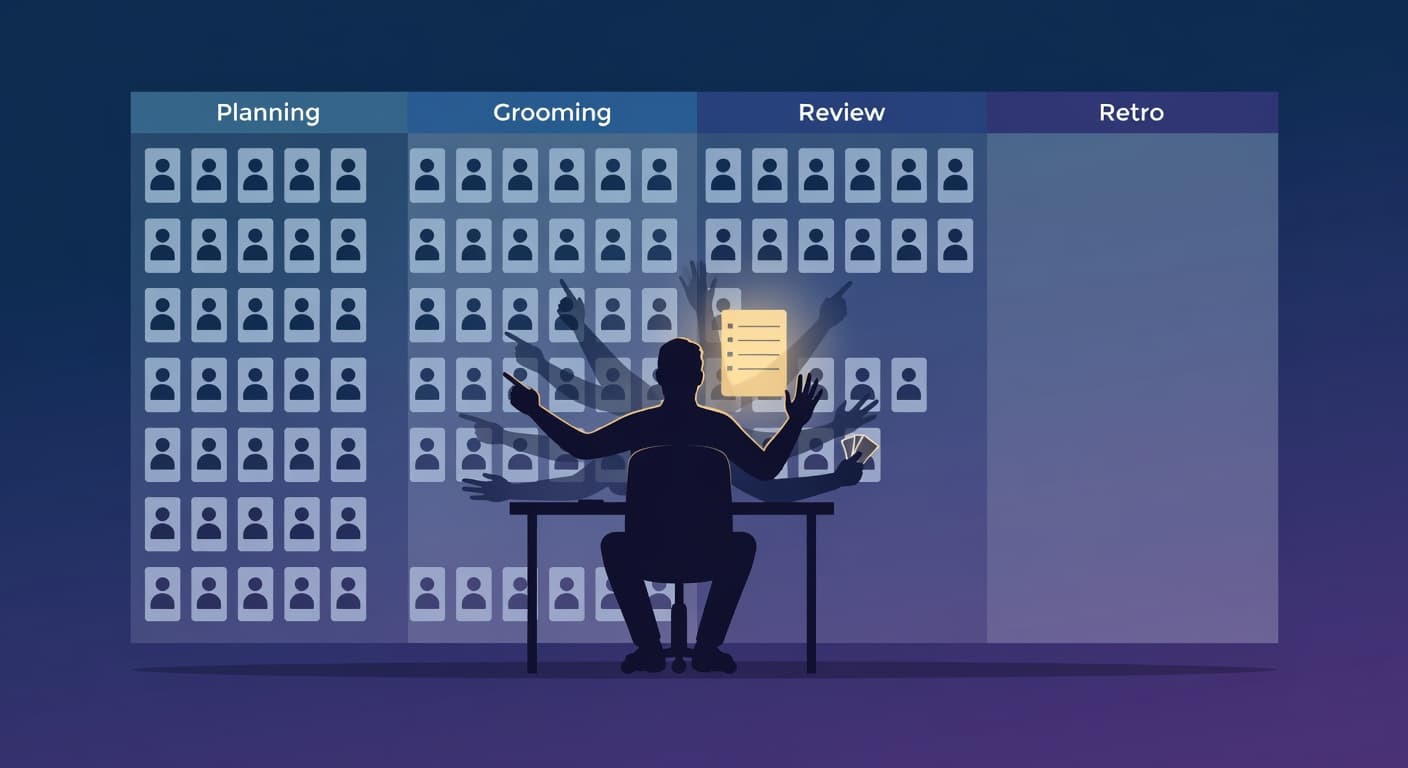
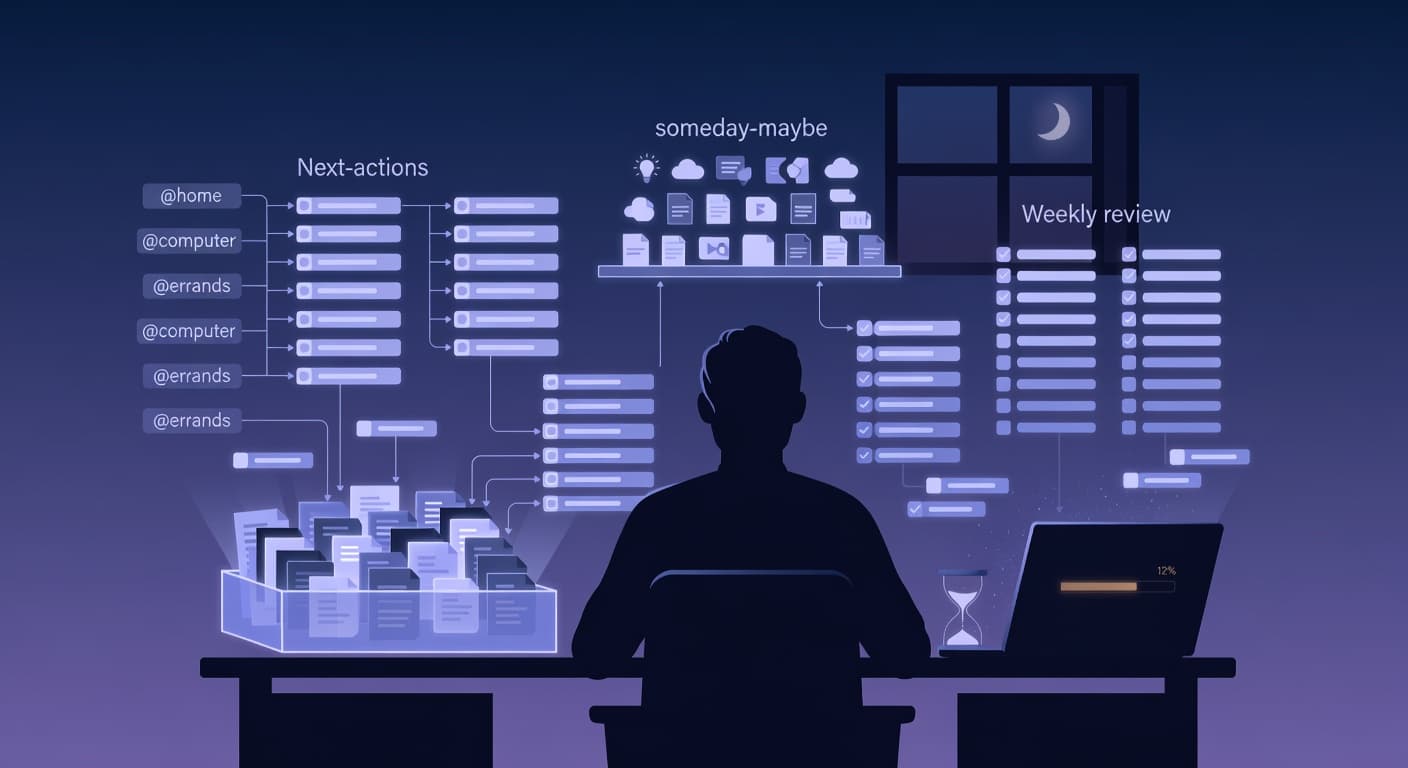
Think about it. Scrum assumes a product owner who prioritizes and a team that negotiates capacity. Kanban assumes multiple workers moving items through stages, creating flow that can be measured and optimized. GTD assumes incoming obligations from other people, things your boss assigns, emails that need responses, meetings that generate action items. Even the Pomodoro technique, which seems individual, was designed in a context where the clock creates urgency against external deadlines set by someone else.
The hidden assumption is always the same: someone else sets your priorities, someone else checks your work, someone else holds you accountable, and someone else tells you when something is good enough to ship.
When you're a solo developer, none of that exists. You are the product owner, the developer, the QA team, the project manager, and the customer all at once. Nobody is setting your priorities except you. Nobody is checking your work except you. Nobody is holding you accountable except your own guilt at 11pm when you realize you spent the whole evening refactoring code that didn't need refactoring.
This is the root of why productivity advice for solo developers needs to be fundamentally different from team advice. It's not that solo devs need a lighter version of the same frameworks. They need different frameworks entirely, built for the actual constraints of working alone.
Teams struggle with coordination: getting multiple people aligned on priorities, dividing work efficiently, communicating changes, managing dependencies. Solo developers struggle with completion: finishing what they start, keeping scope under control, maintaining momentum, making ship-or-kill decisions. These are fundamentally different problems that require fundamentally different tools.
7 Reasons Why Team Productivity Advice Fails Solo Developers
1. "Communicate clearly with your team"
This is the most common advice in every productivity framework, and it's completely irrelevant when you have no team.
Communication advice assumes that misalignment between people is a primary source of wasted effort. For teams, it absolutely is. Miscommunication causes duplicate work, wrong assumptions, and features nobody asked for.
But you have no one to miscommunicate with. Your problem isn't clarity of communication. Your problem is the absence of external input entirely.
What solo developers actually need is manufactured accountability. Without a team to answer to, you need to create external pressure deliberately. This could mean building in public, posting weekly updates on Twitter, telling a friend what you plan to ship by Friday, or joining a community of other indie developers who share progress. The mechanism doesn't matter. What matters is that someone other than you knows what you said you'd do.
2. "Break work into sprints"
I wrote an entire article about why sprint planning is wrong for one person, so I'll keep this brief.
Sprints exist to synchronize a group of people onto a shared cadence. Every two weeks, the team stops, reviews what shipped, and plans the next batch. The cadence creates a heartbeat that keeps everyone aligned.
When you're one person, there's nobody to synchronize with. The sprint cadence assumes predictable, dedicated time, something most side-project developers don't have. You planned five items for this sprint. Then your day job had a crunch week. Then your kid got sick. Then you lost motivation for three days because you hit a technical wall. By the end of the "sprint," you completed one item and carried four forward. Now you're spending time doing sprint planning, sprint review, and sprint retrospective for a sprint that barely produced anything.
What works instead: project-level milestones. "By end of this week, auth works. By end of next week, the dashboard loads real data. By week 4, I ship." No points, no velocity tracking, no ceremonies. Just concrete goals on a timeline you control.
3. "Use a kanban board"
I also wrote about why kanban fails solo developers in detail. The short version: real Kanban is a team coordination system built on WIP limits and pull-based scheduling between multiple workers. A solo dev with three Trello columns is using a to-do list with extra horizontal space.
The seductive part of kanban is that it feels productive. Dragging cards from "To Do" to "In Progress" to "Done" gives you a dopamine hit. But card movement is not project movement. You can have 30 cards in "Done" and still be nowhere close to shipping.
For developer productivity tips solo work actually benefits from: use a locked scope list. Write down the 5 to 7 things that must be done before you can ship v1. Don't add anything else. Work through the list. When everything is checked off, you ship. Ideas for v1.1 go on a separate list that you don't look at until v1 is live.
4. "Estimate your tasks"
Task estimation exists to coordinate expectations between people. A product manager needs to know how long a feature will take so they can plan releases and manage dependencies with other teams. Story points give the team a shared language for "how hard is this?"
When you're the only person, there's no one to communicate estimates to. You already know, roughly, how complex something is because you're the one who's going to build it. Spending 20 minutes debating whether a task is a 3 or a 5 is time you could've spent just doing the task.
Estimation also creates a subtle trap for solo developers. Once you estimate something, you start measuring yourself against the estimate. You told yourself this task would take 4 hours. It's been 6. Now you feel behind. Behind what? Behind a guess you made up?
What actually helps is timeboxing. "I'm going to work on this for 2 hours and see how far I get." No estimate of how long it "should" take. Just a bounded block of time and whatever progress happens within it.
5. "Have daily standups"
The daily standup is a 15-minute meeting where each team member answers three questions: What did you do yesterday? What are you doing today? Is anything blocking you?
This works for teams because the answers create shared awareness. If Developer A finished the API and Developer B is waiting on it, the standup surfaces that handoff.
Doing this alone is absurd. You know what you did yesterday. You know what you're doing today. And if you're blocked, you already know that too because you're the one who's blocked.
But the underlying principle, forcing yourself to articulate progress daily, has real value for indie developer productivity. The problem isn't the idea. It's the format.
Replace the standup with a daily one-line ship log. At the end of each day you work on your project, write one line: what did you complete? Not what you worked on. What you completed. "Finished login flow." "Deployed staging environment." "Fixed the checkout bug." If you can't write a completion line, that tells you something. Maybe you spent the evening yak-shaving. The ship log gives you the same signal as a standup, minus the meeting. This takes 30 seconds.
6. "Do sprint retrospectives"
The sprint retrospective is where the team reflects on the previous sprint. What went well? What didn't? What should we change? It's a structured moment for a group to calibrate their process.
For a solo developer, a biweekly retrospective is overkill. The retro format (went well, didn't go well, action items) is designed for surfacing team dynamics. "Communication with the backend team was slow." "Code reviews took too long." These are team problems. Your problems are about scope creep, motivation, and whether you're actually making progress toward shipping.
Replace the sprint retro with a monthly "closer to shipping?" check. Once a month, ask yourself one question: is this project closer to shipped than it was 30 days ago? If yes, keep going. If no, figure out what's in the way. Maybe you're scope creeping. Maybe you're working on the wrong thing. Maybe the project isn't worth finishing and you should kill it.
I covered the scope creep angle in how to ship faster as a solo developer. The monthly check is the forcing function that makes you confront drift before it eats half a year.
7. "Prioritize with your PM/stakeholders"
In a team, prioritization is a negotiation. The product manager brings business needs. Engineering brings technical constraints. Design brings user research. They argue about what goes into the next release and arrive at a plan that balances all three perspectives.
You are all of these people. And being all of them means none of them has real authority over the others. Your inner product manager wants to add social features. Your inner engineer wants to refactor the database layer. Your inner designer wants to redo the onboarding flow. Without external stakeholders to resolve conflicts, your priorities shift based on whatever feels most interesting or least difficult on any given day.
The fix: use the "would someone pay for this?" filter. For every feature or task you're considering, ask whether it directly contributes to something a user would pay for. If yes, it stays. If no, it goes on the v1.1 list. If you want to go deeper on this, how to prioritize features as a solo developer walks through the full framework.
What to Do Instead
After years of trying every system and watching most of them fail, I've landed on a unified philosophy for indie developer productivity. It has five parts.
Validate ruthlessly. Before you write a line of code, make sure someone other than you wants what you're building. Talk to potential users. Look for people complaining about the problem you're solving. If you can't find evidence that the problem is real, you're building for yourself, which is fine as a hobby but not as a product.
Scope minimally. Define the smallest version of your product that delivers real value. Not the version you're excited about. Not the version with the cool features. The version where someone can use it, get value from it, and potentially pay for it. Five to seven items. That's your v1.
Lock scope. Once you've defined v1, stop adding to it. New ideas go on the v1.1 list. If you've been struggling with GTD or other capture-everything systems, this is the antidote. You don't need to capture every idea. You need to ship one specific thing.
Build with discipline. Timebox your work sessions. Write your daily ship log. Do your monthly "closer to shipping?" check. Skip everything else. No sprints, no story points, no kanban boards, no velocity tracking. Just a locked list and steady progress through it.
Ship publicly. Set a ship date and tell someone about it. Post it on Twitter. Tell your Discord community. Put it in your calendar. The public commitment is what replaces the team accountability you don't have. This is where FoundStep's lifecycle approach connects the dots. It's built around this exact sequence: validate, scope, lock, build, ship. Not because we invented it, but because it's what actually works when you're one person with limited time.
These are the developer productivity tips solo builders actually need. They aren't a framework with certifications and ceremonies. They're a set of habits that account for the reality of working alone.
When Team Advice Still Applies
I've spent this entire article explaining why team productivity advice fails solo developers. And for most cases, that's true. But there are situations where team patterns start to make sense again, even for indie developers.
If you have a cofounder or collaborator. The moment a second person is involved, coordination matters again. Not necessarily full Scrum, but some shared cadence, a weekly sync, shared visibility into what each person is working on, and a way to resolve prioritization disagreements. Two people is a team, even if it's a tiny one.
If you're doing client work. Freelance and contract development involves external stakeholders by definition. Your client is your product owner. Some team patterns, like sprint reviews where you demo progress, work well here because they serve their original purpose: creating shared understanding between people with different roles.
If you eventually hire. Many indie projects that succeed eventually need help. When you bring on a part-time contractor or a first employee, you need coordination mechanisms. At that point, lightweight agile practices start earning their keep. But start light.
The pattern is simple: when other people are involved, use team advice. When you're alone, use solo advice. Good productivity advice for solo developers acknowledges this distinction. Most productivity content skips it entirely, which is why you've been frustrated.
Frequently Asked Questions
Why doesn't standard productivity advice work for solo developers?
Because it assumes someone else is setting your priorities, checking your work, and holding you accountable. Solo developers have none of this. Every popular productivity method, from Scrum to GTD to Kanban, was designed in a context where multiple people interact. The accountability, the feedback loops, the prioritization negotiations, they all require at least two people to function. Productivity advice for solo developers needs to account for the absence of all this external structure.
What productivity system works for solo developers?
Validate ruthlessly, scope minimally, lock scope, build with discipline, ship publicly. Skip the team ceremonies and focus on the things that actually move a project from idea to shipped. This isn't a formal system with certifications and tooling. It's a set of habits designed for one person with limited time. The validation step prevents you from building something nobody wants. The scoping step prevents you from building too much. The scope lock prevents drift. The discipline keeps you moving. And the public shipping commitment replaces the team accountability you don't have.
Should solo developers do daily standups?
Not in the traditional sense. A standup is a 15-minute meeting where team members share status. You already know your own status. But the principle behind standups, forcing yourself to articulate progress daily, is genuinely useful. Replace standups with a daily one-line ship log: what did you complete today? Not what you worked on. What you finished. "Deployed the auth flow." "Fixed the billing bug." Takes 30 seconds, no meeting required.
Is agile methodology useful for solo developers?
The philosophy works. Iterate quickly, ship small increments, get feedback early, respond to change. These principles are universally applicable regardless of team size. But the practices, sprints, standups, retros, planning poker, backlog grooming, are coordination ceremonies designed for groups. They add overhead that only pays for itself when multiple people need to stay aligned. As a solo developer, take the agile mindset and leave the agile process. Build small. Ship often. Get feedback. Adjust. You don't need a two-week sprint to do that.
Here's what to do today:
- Audit your current process. How much of it was designed for a team? Delete those parts.
- Pick one unfinished project and cut the scope to the smallest shippable version.
- Lock that scope. Build it. Ship it. Or kill it.
Most productivity advice assumes you have a team. You don't. Stop borrowing their systems and start using one built for solo developers. Try FoundStep and ship your next project with a workflow designed for how you actually work.

Ready to ship your side project?
FoundStep helps indie developers validate ideas, lock scope, and actually finish what they start. Stop starting. Start finishing.
Get Started Free