How to Launch a Side Project as a Solo Developer

Your First Launch Should Be Boring
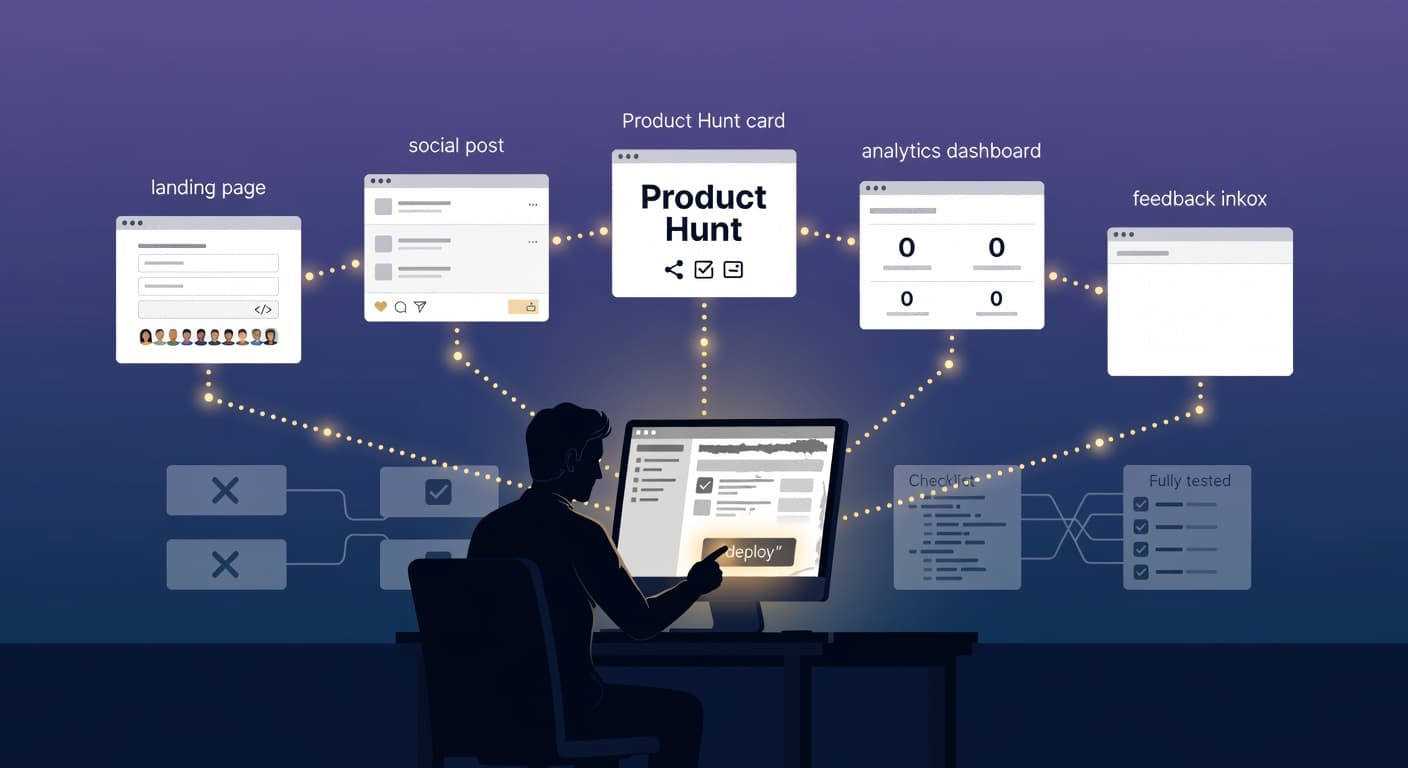
When most solo developers think about how to launch a side project, they picture a big event. A Product Hunt page with a polished video. A Twitter thread that goes viral. A Hacker News post sitting at #1. Maybe a blog post with a backstory about how you quit your job to build this thing.
That picture is wrong. Or at least, it's wrong for v1.
I've launched multiple side projects. The ones that survived had boring first launches. I deployed them, sent DMs to a handful of people, asked them to try it, and listened to what they said. No fanfare. No logo reveal. No launch day countdown. Just a live URL and a few conversations.
The ones that died? Those had beautiful landing pages, a Twitter announcement, and zero feedback loops. I optimized for attention instead of information. Big mistake.
If you want to launch a side project as a solo developer, here's the mindset shift: your v1 launch is not a marketing event. It's a research event. The goal is validation, not virality. You're trying to learn whether this thing solves a real problem for real people. Everything else comes later.
Why Launching Is Harder for Solo Developers
On a team, launching is a shared responsibility. Someone handles deployment. Someone writes the launch copy. Someone manages the social accounts. Someone sets up analytics. The work is divided, and nobody has to be good at everything.
You have to be good at everything. Or at least, competent enough at everything. And that's paralyzing.
I've seen the same pattern over and over. A developer finishes the core product, then spends six weeks building a landing page, writing blog posts, setting up a newsletter, configuring analytics, designing social media assets, and researching the "best time to post on Product Hunt." They never actually launch. The preparation becomes the project.
There's also a fear element that's hard to talk about. Launching means people will see your work. They might think it's bad. They might say nothing at all, which somehow feels worse. When you're on a team, a failed launch is the team's failure. When you're solo, a failed launch is your failure. So you delay. You add one more feature. You redesign the onboarding. You tell yourself you'll launch "next week" for three months.
Perfectionism is real, and it's the most common reason solo developers never launch. But here's the thing: nobody remembers your v1. Nobody. People remember the product that eventually worked, not the rough version you showed to 10 people in February. So stop polishing and start deploying. Learning how to launch a side project as a solo developer starts with accepting that imperfect and live beats perfect and private.
Step 1: Deploy Before You're Ready
This sounds counterintuitive, but bear with me. Deploy your side project on day one. Before you have features. Before you have a design. Deploy a blank page to production.
Why? Because deployment anxiety is real and it compounds over time. The longer you wait to deploy, the scarier it gets. You start imagining everything that could go wrong. SSL certificates, environment variables, database migrations, DNS propagation. It becomes this massive task that you keep pushing off.
But if you deploy a blank Next.js app to Vercel on the first day of your project, deployment is no longer an unknown. It's a solved problem. Every subsequent deploy is just a git push. The fear evaporates because you've already done it.
Here's what this looks like in practice:
- Create your repo
- Push to GitHub
- Connect to Vercel (or Railway, or Fly.io, or whatever you use)
- Point your domain at it
- You now have a live URL serving a blank page
Congratulations. You've deployed your side project. The hardest part of deployment is behind you, and you haven't even built anything yet. Every feature you add from now on goes live automatically.
This also forces you to deal with environment variables, build errors, and configuration issues early, when they're easy to fix. Not two months from now when you've built a complex app and deployment fails for reasons you can't debug at 2 AM on launch night.
Step 2: Build Your Side Project Launch Checklist
Before you get close to telling anyone about your project, you need infrastructure in place. Not a landing page. Not a blog. Infrastructure. Here's a side project launch checklist that covers the minimum:
Non-negotiable before telling anyone:
- Custom domain connected and working
- HTTPS configured (most hosts handle this automatically)
- Error tracking set up (Sentry free tier is fine)
- Basic analytics installed (Plausible, Umami, or even just Vercel Analytics)
- A feedback mechanism (can be as simple as a mailto link or a Tally form)
- Core features work without crashing
Nice to have but not blocking:
- Open Graph tags so links look decent when shared
- A favicon (seriously, it takes 5 minutes, just do it)
- Mobile responsiveness for core flows
- A /privacy page if you collect any data
Not needed for v1:
- A landing page
- A blog
- Social media accounts
- A newsletter
- Custom email domain
- A terms of service page
- A pricing page (charge later)
That last section is where solo developers waste the most time. You don't need a marketing website to launch a side project. You need to deploy your side project, set up a feedback channel, and start talking to people. That's the whole checklist.
Step 3: Skip the Landing Page for V1
This is the most controversial thing I'll say in this post, and I stand by it: you don't need a landing page for your v1 launch.
"But how will people know what my product does?"
You'll tell them. Personally. In a DM. In a sentence.
If your product needs a landing page to explain what it does, your product isn't clear enough yet. A landing page is a marketing tool. For v1, you're not doing marketing. You're doing research.
Here's what I mean. When you DM someone and say "hey, I built a tool that tracks your side project progress and tells you which ones are stalled, want to try it?" they either get it or they don't. If they don't get it from one sentence, a landing page with fancy animations won't help. The product itself needs to be clearer.
Landing pages become useful when you're trying to convert strangers. People who don't know you, who found you through search or social media, who need to be convinced. That's v1.1 territory. For v1, you're reaching out to people directly. They don't need a sales page. They need a URL and a one-line explanation.
Build the landing page later, when you know what language actually resonates with users. Your v1 users will tell you, in their own words, what your product does and why they like it. Use their words on the landing page. That copy will convert better than anything you write in isolation.
Step 4: Tell 10 People Personally
Here's the core of the solo developer launch strategy. Don't announce. Don't post. Don't tweet. DM 10 people who have the problem your product solves.
Not 10 friends. Not 10 family members. Not 10 fellow developers who will tell you "looks great!" and never log in again. Ten people who have publicly expressed frustration with the problem you're solving.
Where do you find them?
- Twitter/X: Search for people complaining about the problem. "I wish there was a tool that..." or "why is [thing] so hard" or "spent 3 hours trying to..."
- Reddit: Find the subreddits where your target users hang out. Look for posts asking for recommendations or venting about existing tools.
- Discord/Slack communities: Developer communities, indie hacker groups, niche communities related to your product's domain.
- Forums: Stack Overflow (for developer tools), specific industry forums, Indie Hackers.
Your DM should be short and direct. Something like:
"Hey, I saw your post about [specific problem]. I built a small tool that [one-sentence description]. It's rough but it works. Would you be willing to try it and tell me what's broken? No charge, just looking for honest feedback."
Most people won't respond. That's fine. You need 10 to try it, which means you might need to DM 30 to 50 people. The response rate for a genuine, personalized DM is higher than you'd expect. People like being asked for their opinion, especially when the ask is specific.
What you're doing here is a manual version of distribution. You're hand-delivering your product to the people who need it. This doesn't scale, and it's not supposed to. Scaling comes after you've confirmed the product works.
Step 5: Collect Feedback Before You Do Any Marketing
Your first 10 users are not customers. They're co-designers. Their job is to tell you what's broken, what's confusing, and what's missing. Your job is to listen without getting defensive.
Set up a simple feedback loop:
- After they've used it for a few days, ask them three questions: What did you try to do? What worked? What didn't?
- Watch for patterns. If 3 out of 10 people get stuck on the same screen, that screen is broken. If 7 out of 10 people ask for the same feature, that feature should be in v1.1.
- Pay attention to what they do, not just what they say. If someone says "it's great" but hasn't logged in for a week, it's not great. It's forgettable.
The feedback you collect here will save you months. Without it, you're guessing what to build next. With it, you have a prioritized list of real problems from real users. This is the data that makes your v1.1 actually useful instead of just bigger.
I know this feels slow. You want to post on Product Hunt and see the upvotes roll in. But launching to the world before you've fixed the obvious problems is like inviting 500 people to a restaurant on opening night when the kitchen catches fire every third order. You get attention, sure. But it's the wrong kind.
If you want to learn more about how to prioritize what your users tell you, I wrote about how to prioritize features as a solo developer. The short version: fix what blocks people first, add what they request second, build what you think is cool third.
Step 6: Ship V1.1 Within Two Weeks
Here's where most solo developers stall out after their quiet launch. They collect feedback, nod along, add everything to a backlog, and then spend two months rebuilding the product from scratch. Don't do that.
Ship v1.1 within two weeks of your v1 launch. Not a major rewrite. A fast follow-up that fixes the top 3 to 5 issues your early users flagged.
This does two things. First, it proves to your early users that you're serious. Nothing kills early adoption faster than a developer who asks for feedback and then goes silent. When someone reports a bug on Tuesday and it's fixed by Thursday, they become an advocate. They tell their friends. They stick around.
Second, it builds your shipping muscle. If you wait two months between v1 and v1.1, the gap will keep growing. V1.2 will take three months. V1.3 will take six. But if you force yourself to ship every two weeks, the cadence becomes habit. I wrote about building that kind of momentum in how to ship faster as a solo developer.
FoundStep was designed with this kind of iterative shipping in mind. You break your project into concrete milestones, track what you've committed to, and resist the urge to keep adding scope mid-cycle. The tight feedback loop between launch, feedback, and iteration is where products actually get good.
Your v1.1 scope should look something like:
- Fix the top 3 bugs from user feedback
- Add the 1 to 2 features that multiple users asked for
- Improve the most confusing screen (the one where people got stuck)
- Maybe add that landing page now (use language from user feedback)
That's it. Keep it tight. Ship it fast.
Step 7: Now Do the Marketing Launch
After v1.1, you've earned the right to do a "real" launch. You have a product that works. You have early users who can vouch for it. You've fixed the obvious problems. Now you can go wide.
This is when you do Product Hunt. This is when you write the Twitter thread. This is when you post on Hacker News. This is when the landing page matters.
Your marketing launch is fundamentally different from your v1 launch because you have data. You know what resonates with users because real people told you. You know which features to lead with because you watched people use the product. You know how to describe it because you've had 10 conversations about it.
Here's a rough marketing launch sequence:
- Update your landing page with copy based on real user feedback. Use their words, not yours.
- Get 2 to 3 testimonials from your early users. Even a simple "I use this for X and it saves me Y" works.
- Write a launch post that tells the story honestly. How you built it, what you learned, what's next. Developers respect transparency.
- Post on Product Hunt midweek (Tuesday through Thursday tends to work best). Product Hunt's launch guide covers how to prepare assets and time your post. Have your early users ready to comment with genuine experiences.
- Share on Hacker News with a Show HN post. Keep it factual. Don't hype. Technical founders get especially honest feedback here.
- Write a Twitter/X thread about the building process. What worked, what didn't, what surprised you.
The key difference between a solo developer launch that works and one that doesn't is timing. Launching v1 to the world is too early. Launching v1.1 to the world, after real users have battle-tested it, is the right time.
Launch Platforms for Solo Developers
Here's where to share your shipped project, ranked by effort and impact:
Product Hunt — Best for SaaS products, developer tools, and apps with clear visual appeal. High potential reach but competitive. Requires assets and timing.
Hacker News (Show HN) — Best for technical products, open-source tools, and novel approaches. No preparation needed. Brutally honest feedback. Can drive significant traffic if it resonates.
Reddit (relevant subreddits) — Best for niche products serving specific communities. r/SideProject, r/InternetIsBeautiful, or niche topic subreddits. Share the story, not just a link.
Indie Hackers — Best for products aimed at developers, founders, or makers. Community responds well to honest build-in-public stories. Build in public as you go and your launch will already have an audience.
Three channels on launch day is enough. Don't spread yourself across 15 platforms. Depth beats breadth.
Common Mistakes That Kill Solo Developer Launches
I've watched (and made) these mistakes enough times to spot them instantly.
Waiting for perfection. Your v1 will have bugs. It will look rough. Some features will be half-baked. That's expected. If you wait until everything is polished, you'll never launch. Remember, your v1 audience is 10 forgiving early adopters, not the front page of Hacker News.
Launching to nobody. Posting a link on your personal Twitter account with 47 followers and hoping for the best is not a launch strategy. If you don't personally DM people who have the problem, nobody will find your product. Distribution doesn't happen by accident for solo developers.
Skipping the feedback step. Going straight from v1 to Product Hunt means you're presenting your best guesses to a large audience. Your guesses about what matters, what to emphasize, what to fix. That's a gamble. The feedback step turns guesses into knowledge.
Building a landing page instead of a product. I've seen developers spend more time on their landing page than on their actual product. The landing page looked incredible. The product behind it crashed on the second click. Users don't care how pretty your marketing is if the product doesn't work.
Treating launch as a single event. A solo developer launch is not one moment. It's a process. V1 to 10 people, feedback, v1.1, marketing launch, continued iteration. Thinking of it as a single do-or-die day creates unnecessary pressure and usually leads to disappointment.
Not having a feedback channel. You launched. Someone found a bug. How do they tell you? If the answer is "I guess they could find my GitHub and open an issue," you've lost that feedback. Put a feedback form, an email link, or a chat widget in the product itself. Make it obvious.
How to Launch a Side Project as a Solo Developer: The Real Checklist
Here's everything in order. Print this out, stick it on your wall, check things off as you go.
- Deploy to production on day one (blank page is fine)
- Build core features (5 to 7 max)
- Set up error tracking and analytics
- Add a feedback mechanism to the product
- DM 10 people who have the problem
- Collect feedback for 1 to 2 weeks
- Ship v1.1 fixing top issues within 2 weeks
- Build a landing page using real user language
- Get 2 to 3 testimonials from early users
- Do the marketing launch (Product Hunt, Twitter, HN)
- Keep shipping every 2 weeks
That's the entire process to launch a side project as a solo developer. No launch budget required. No marketing team. No PR strategy. Just a working product, 10 honest conversations, and the discipline to ship fast and iterate.
If you're still in the idea stage, go read how to validate ideas as a solo developer first. Launching a project nobody wants is worse than not launching at all. And if you're worried about scope creep derailing your launch timeline, best project management for solo developers covers how to keep your project on track without drowning in process.
FAQ
When should I launch my side project?
When your core features work and you can explain what it does in one sentence. You don't need a perfect landing page, a blog, or a social media strategy for v1. Ship it, get feedback, improve.
Should I launch on Product Hunt?
Not for v1. Launch v1 quietly to 10 people who have the problem you're solving. Fix what they tell you is broken. Launch v1.1 on Product Hunt when the obvious problems are fixed.
What's the minimum I need to launch a side project?
A deployed product, a way to collect feedback (email form or DMs), and 10 people to tell. That's it. No landing page, no blog, no social media campaign needed for v1.
How do I get my first 10 users?
DM 10 people who have the problem your product solves. Not friends, not family. People in communities, forums, or Twitter who have publicly complained about the problem.
Your side project doesn't need a perfect launch. It needs a live URL and 10 honest conversations. Get started with FoundStep and stop planning your launch, start shipping it.

Ready to ship your side project?
FoundStep helps indie developers validate ideas, lock scope, and actually finish what they start. Stop starting. Start finishing.
Get Started Free